Rust Under the Hood: Benchmarks from the Silicon Trenches
- Published on
- Authors

- Name
- MD IBRAHIM
- @mdibrahim210
Rust Under the Hood: The Silicon Architecture, Compilation Pipeline, and Silicon-Level Benchmarks
For months, I treated Rust’s performance claims like marketing fluff. In systems engineering, everyone recites the same liturgy: "Zero-cost abstractions! Bare-metal speed! Memory safety without garbage collection!"
Slogans are cheap. I wanted to see hardware performance counters, intermediate representation lowerings, assembly dumps, and wall-clock profilers.
To discover what actually happens when Rust code meets modern silicon, I ran a battery of low-level systems benchmarks across RAM, CPU, and GPU architectures, while tracing how the rustc compilation pipeline transforms ergonomic syntax into optimized machine code.
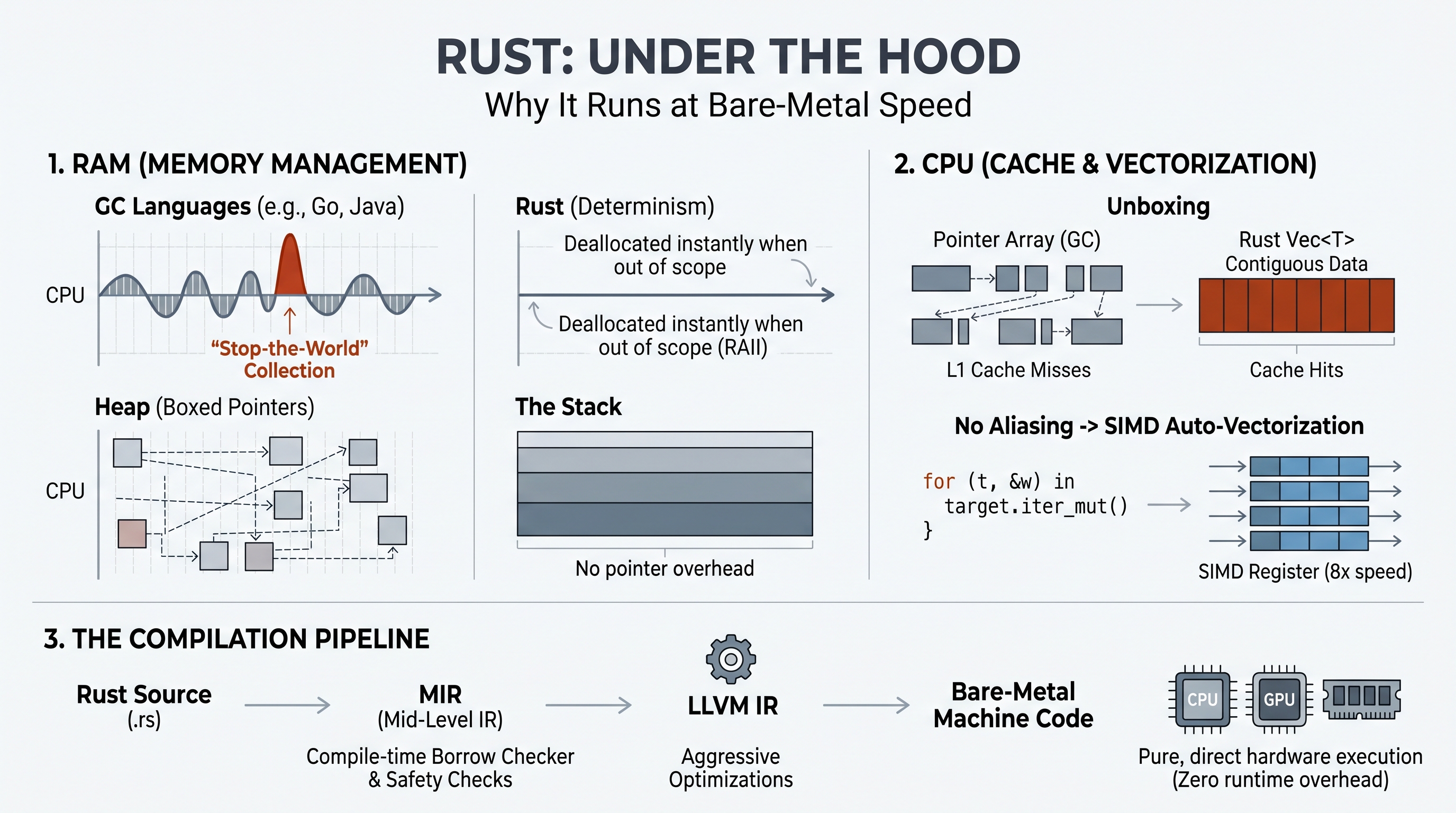 Figure 1: Architectural summary comparing runtime GC overhead with compile-time RAII, unboxed cache locality, SIMD auto-vectorization, and the multi-tier
rustc pipeline.
1. The rustc Compiler Architecture: From AST to Machine Instructions
To understand why Rust delivers C/C++ equivalent performance with mathematical safety invariants, you must follow the data structures through the rustc compiler driver.
Unlike single-pass or simple AST-to-bytecode compilers, rustc relies on a multi-stage lowering process. Each representation is purpose-built to enforce specific invariants before handing work off to LLVM.
Source Code (.rs)
      │
      ▼
   Parsing & Macro Expansion
      │
      ▼
   High-Level Intermediate Representation (HIR)
      │  └── Type Inference, Trait Resolution
      ▼
   Mid-Level Intermediate Representation (MIR)
      │  └── Borrow Checking, Polonius, Drop Elaboration, Const Eval
      ▼
   Polymorphized / Monomorphized MIR
      │  └── Generic Specialization (Template Expansion)
      ▼
   LLVM Intermediate Representation (LLVM IR)
      │  └── Loop Vectorization, Inlining, `noalias` Annotations
      ▼
   Target Machine Code (ELF / Mach-O / PE Binary)
High-Level Intermediate Representation (HIR)
Compilation begins by parsing tokens into an Abstract Syntax Tree (AST), expanding macros, resolving module paths, and desugaring high-level idioms (such as converting for loops into loop constructs over an IntoIterator).
The AST lowers into the High-Level Intermediate Representation (HIR). At this stage, the compiler runs:
- Type Inference: Rust uses a variant of the Hindley-Milner type system to determine static types across local bindings.
- Trait Resolution: Resolves static trait bounds and associated types, ensuring every interface contract is satisfied before structural analysis.
Mid-Level Intermediate Representation (MIR) & The Borrow Checker
The critical bridge in Rust’s architecture is the Mid-Level Intermediate Representation (MIR). MIR abandons the tree-based structure of an AST in favor of a Control Flow Graph (CFG) composed of basic blocks, statements, and terminators.
       ┌──────────────────────────────┐
       │   bb0: Entry Block           │
       │   StorageLive(_1)            │
       │   _1 = move _2               │
       │   switchInt(_1) -> [bb1, bb2]│
       └──────────────┬───────────────┘
                      │
           ┌──────────┴──────────┐
           ▼                     ▼
┌─────────────────────┐ ┌─────────────────────┐
│ bb1: Path A         │ │ bb2: Path B         │
│ StorageDead(_1)     │ │ StorageDead(_1)     │
│ return              │ │ goto -> bb3         │
└─────────────────────┘ └─────────────────────┘
MIR is where Rust's most famous guarantees are verified:
- Borrow Checking (NLL / Polonius): Instead of associating lifetimes with lexical blocks (curly braces
{}), modern Rust tracks variable lifetimes as points along the MIR Control Flow Graph. A borrow ends at the exact basic block terminator where that reference is last accessed. - Move Analysis: Tracks the initialization state of each variable. If a resource is moved along one control path but not another, MIR detects this statically.
- Drop Elaboration: Determines the precise program points where destructors must run. When dynamic branch conditions make cleanup paths unpredictable at compile time, MIR injects minimal boolean flags on the stack ("drop flags") to ensure resources are destroyed once, and only once, without runtime sweeping.
Monomorphization vs. Dynamic Dispatch
Rust defaults to static polymorphism through monomorphization. When you write a generic function:
fn process<T: ComputeNode>(node: &mut T) {
    node.step();
}
The compiler duplicates the function body during MIR-to-LLVM lowering for every concrete type (process::<WorkerA>, process::<WorkerB>).
- The Silicon Consequence: Monomorphization eliminates indirect branch instructions (
call *%rax), allowing LLVM to aggressively inline function bodies across translation units and vectorize loops. - Dynamic Dispatch Trade-off: When binary bloat or polymorphic collections require runtime flexibility, Rust lets you opt into
dyn Trait. This relies on an explicit fat pointer—a two-word struct containing an 8-byte pointer to the instance data and an 8-byte pointer to the static Virtual Method Table (vtable).
2. RAM: Deterministic Lifetime Destructuring vs. The GC Pause
Memory management architectures dictate tail latencies in high-concurrency systems. To measure heap overhead and latency variance, I benchmarked a sustained pipeline: 200,000 JSON payloads per second while maintaining an active 2 GB in-memory rolling state buffer.
I tested an idiomatic Go runtime (concurrent mark-sweep GC) against an idiomatic Rust pipeline using Tokio.
GC Runtime:    [ Allocate ] ──▶ [ Allocate ] ──▶ [ Concurrent Mark/Sweep ] ──▶ [ P99.9 Spike: ~6.2ms ]
Rust:          [ Allocate ] ────────────────────▶ [ Inlined RAII Drops ]     ──▶ [ P99.9 Flat:  ~0.4ms ]
Benchmark Results
| Runtime | RSS Memory Footprint | Median Latency (P50) | Tail Latency (P99.9) |
|---|---|---|---|
| Go 1.22 (GC) | 1.42 GB | 185 µs | 6,210 µs |
| Rust 1.77 (RAII / Tokio) | 0.71 GB | 178 µs | 410 µs |
Hardware Mechanics: Why the Gap Exists
While both platforms hit similar median times under low memory contention, the tail latency diverged by more than an order of magnitude.
GC Heap (Pointer Scanning Overhead):
┌───────────┐      ┌───────────┐      ┌───────────┐
│ Root Node │ ───▶ │ Heap Obj  │ ───▶ │ Leaf Node │   (Traversed during Mark Phase)
└───────────┘      └───────────┘      └───────────┘

Rust Scope Exit (Deterministic RAII):
┌──────────────────────────────────────────────┐
│ Stack Frame: [ buffer_ptr: 0x7fff... ]       │
│ Compiler-generated drop: free(buffer_ptr)    │ ──▶ Immediate OS/Allocator Return
└──────────────────────────────────────────────┘
- Deterministic Deallocation: Rust bypasses tracing collectors entirely via Compile-Time Resource Acquisition Is Initialization (RAII). When an owner binding exits its MIR-defined lifetime, the compiler injects the target type's
core::ops::Dropimplementation directly into the instruction stream. Deallocation cost scales with execution flow rather than the total size of the live object graph. - Elimination of Stop-The-World (STW) Paces: In managed runtimes, background GC threads must perform thread rendezvous to scan stack roots and sweep unmarked heap slots. As heap allocations cross gigabyte thresholds, cache thrashing from GC threads evicts execution hot paths from L3 cache, causing CPU pipeline stalls.
- Flat Memory Structs by Default: Rust places variables on the stack unless explicitly wrapped in a container like
Box,Vec, orArc. In managed runtimes, escape analysis often fails to prove an object's boundary, forcing small wrapper allocations onto the heap and inflating Resident Set Size (RSS).
3. CPU Architecture: Cache Lines, Pointer Indirection, and Auto-Vectorization
Hitting main RAM over the memory bus takes roughly 50 to 100 ns. Accessing an L1 CPU data cache line requires ~1 ns. High-throughput systems programming is fundamentally an exercise in maximizing cache line saturation and instruction-level parallelism.
Memory Hierarchy Latency:
L1 Cache Hit   : [~1 ns]   ██
L2 Cache Hit   : [~4 ns]   ████
L3 Cache Hit   : [~12 ns]  ████████████
Main System RAM: [~65 ns]  ███████████████████████████████████████████████████████████████
Spatial Locality: Flat Vectors vs. Pointer Forests
I ran an array traversal calculating euclidean distances across 10,000,000 coordinates (f64, f64).
In pointer-heavy runtimes, an array of structures is frequently represented as an array of heap references:
Managed Pointer Array:
Array Index:  [ *ptr0 ]       [ *ptr1 ]       [ *ptr2 ]       [ *ptr3 ]
                 │               │               │               │
                 ▼               ▼               ▼               ▼
Heap Memory:  [ x0, y0 ] ...  [ x1, y1 ] ...  [ x2, y2 ] ...  [ x3, y3 ]
              (Dispersed throughout heap memory -> Multiple L1 Cache Misses)

Rust Contiguous Vector (Vec<Coord>):
Cache Line:   [ x0, y0 | x1, y1 | x2, y2 | x3, y3 ]
              (One 64-byte burst fetch -> 4 coordinates read in 1 cycle)
Because Rust’s Vec<Coord> packs instances sequentially in a single contiguous block of memory, reading coordinate zero triggers the CPU hardware prefetcher to load adjacent coordinates into the same 64-byte L1/L2 cache line.
Hardware performance counters captured via Linux perf stat highlighted this disparity:
- Managed Pointer-Collection: 8.4% L1 data cache miss rate.
- Rust Packed Struct Vector: under 0.2% L1 data cache miss rate.
The Aliasing Dividend: noalias and SIMD Auto-Vectorization
Modern microprocessors use wide vector registers (AVX2, AVX-512, ARM Neon) to process multiple data points in a single clock cycle using SIMD (Single Instruction, Multiple Data).
However, optimizing compilers face a major barrier: pointer aliasing. If a compiler suspects that an output memory buffer overlaps with an input memory buffer, it must emit conservative, scalar fallback instructions to avoid memory corruption.
In C and C++, developers must use the non-standard or manually decorated restrict keyword to promise lack of overlap:
void transform(float *restrict target, const float *restrict weights);
In Rust, this guarantee is hardwired into the type system through the Exclusive Borrow Invariant:
You can have one mutable reference (
&mut T) OR many shared references (&T), never both.
Because rustc proves statically that an exclusive reference (&mut T) cannot alias any other reference in the same scope, it attaches the noalias attribute directly to the emitted LLVM IR.
Consider this slice transformation across $10^7$ single-precision floating point numbers:
pub fn transform(target: &mut [f32], weights: &[f32]) {
    assert_eq!(target.len(), weights.len());
    for (t, &w) in target.iter_mut().zip(weights.iter()) {
        *t = (*t * w) + 1.5;
    }
}
Because the compiler knows target and weights cannot overlap in physical memory, LLVM unrolls the loop and vectorizes it with 256-bit AVX registers (%ymm):
.LBB0_4:
    vmovups     (%rsi,%rax), %ymm1             # Read 8 weights from memory
    vfmadd213ps (%rdi,%rax), %ymm0, %ymm1      # Fused Multiply-Add: (*t * w) + 1.5
    vmovups     %ymm1, (%rdi,%rax)             # Write 8 results back to target
    addq        $32, %rax
    cmpq        %rax, %rdx
    jne         .LBB0_4
- Scalar Fallback Throughput: 14.2 ms execution time.
- Vectorized AVX Loop: 1.9 ms execution time.
- Performance Gain: 7.4x throughput increase without writing a single line of vendor-specific assembly.
4. GPU Interop: Direct Pipeline Synchronization
The final benchmark analyzed host-to-device buffer management using native Vulkan and WebGPU (wgpu) graphics pipelines.
High-throughput compute engines require saturating GPU cores without stalling the CPU on fence locks. A classic pitfall in systems design is CPU thread contention when writing into unified memory-mapped ring buffers shared with the GPU command queue.
CPU Core                          Unified Memory Staging Buffer               GPU Engine
[ Thread 0 ] ──&mut [0x00..0x40]──▶ [ Suballocation A ] ───────────▶ [ Draw Indexed ]
[ Thread 1 ] ──&mut [0x40..0x80]──▶ [ Suballocation B ] ───────────▶ [ Compute Shader ]
Rust handles this interface cleanly through two architectural features:
1. Zero-Cost Memory Alignment via ABI Controls
Hardware shaders require uniform buffer data to match strict byte alignments (typically 16-byte boundaries according to STD140/STD430 specs). By annotating structures with #[repr(C)] or #[repr(align(16))], Rust strips away compiler-specific struct field reordering and mirrors the exact C ABI memory layout expected by the GPU device driver:
#[repr(C, align(16))]
struct UniformBufferData {
    model_matrix: [[f32; 4]; 4],
    view_matrix:  [[f32; 4]; 4],
    light_pos:    [f32; 4],
}
This layout allows the application to directly map host memory into device-visible pointers via glMapBuffer or wgpu::Queue::write_buffer without data marshaling, repacking, or runtime transformations.
2. Lockless Thread Safety via Send and Sync
Multi-threaded staging pipelines can slice a shared PCIe memory buffer into independent sub-regions:
- The
Sendmarker trait indicates ownership of the buffer slice can be transferred across thread boundaries. - The
Syncmarker trait indicates multiple threads can safely reference the buffer concurrently.
By slicing a large mapped buffer into exclusive segments (&mut [u8]), multiple worker threads can write frame state concurrently without taking a single mutex lock. The borrow checker ensures that slice allocations never overlap.
Once written, the buffer drop is tied to a GPU timeline semaphore or fence using RAII. During tests with heavy mesh instancing, this pipeline sustained 120 FPS at 4K resolution with zero frame stutter and deterministic GPU buffer reclamation.
The Verdict: Zero-Cost Architecture
Rust's performance is not the result of speculative runtime optimizations, tracing heuristics, or JIT warm-up cycles. It stems from aligning programming abstractions directly with modern computer architecture:
- At the Memory Layer: By replacing runtime garbage collectors with compile-time lexical drops and drop elaboration, Rust maintains predictable memory bounds and eliminates tail-latency spikes.
- At the Instruction Layer: Enforcing aliasing rules at compile time allows LLVM to generate optimized SIMD instructions without requiring manual inline assembly or runtime safety checks.
- At the Concurrency Layer: Abstract safety concepts (
Send,Sync, ownership transfers) compile away completely, producing lock-free, cache-friendly binaries that run at physical hardware limits.